
Meet us at the Anaheim Trade and Manufacturing Show Booth #216

Capability

High-volume wire manufacturing where unit two thousand matches unit one.

Production runs demand a different discipline than prototypes: fixtured builds, automated crimping with validated tooling, in-process inspection, and 100% electrical test on every assembly. Same USA facility, same quality system, built to run.

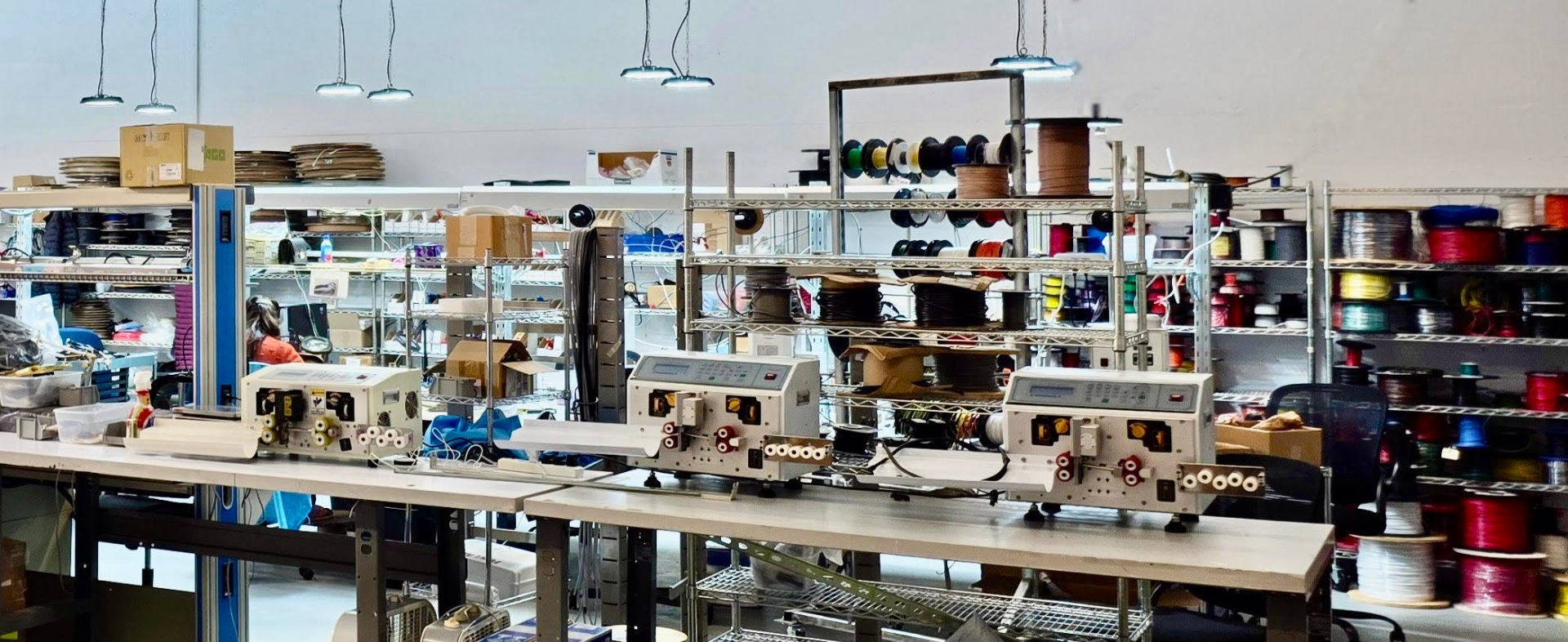
Production floor set up for high-volume wire harness manufacturing

Capabilities & standards

  • Fully automatic cut, strip, and crimp for production volumes
  • Crimp height and pull-force validation on a documented interval
  • Fixtured layout boards for repeatable multi-branch harnesses
  • Automatic wire twisting, labeling, and marking
  • In-process inspection plus 100% continuity and hipot test
  • Blanket orders, scheduled releases, and kitted packaging
ISO 9001:2015IPC/WHMA-A-620Made in USA
Request a quote

Volume is a process question, not a capacity question

Scaling an assembly is mostly about removing variation. Where a prototype tolerates a skilled operator making judgment calls, a production run needs those calls made once, documented, and then repeated identically — in the layout, the tooling, the strip lengths, and the acceptance criteria.

We do that work up front. Before a run goes to volume, the build is fixtured, the work instruction is written against your drawing revision, and the tooling is qualified with pull-force data. After that, output is predictable.

Where the cost actually comes out

Unit cost at volume comes from automation and batching, not from cutting corners on workmanship. Automated cut-and-strip removes handling time, batch termination keeps setups down, and consolidated material buys improve component pricing.

Design details matter too. Sometimes a small change to a strip length, a connector family, or a sleeving choice takes real cost out of a high-volume assembly. If we see one, we bring it to you as an option — you decide whether to change the print.

Testing every unit, not a sample

Every assembly is electrically tested. Continuity on all builds, with hipot or insulation resistance where your acceptance criteria require it. On a large run, sampling is how escapes reach the field, so we do not sample the electrical test.

Records ship with the lot, tied to your part number and drawing revision, so your incoming inspection has the evidence it needs without chasing us for it.

Delivered on your build plan

Most volume customers work from blanket orders with scheduled releases: pricing is locked, material is staged against forecast, and assemblies arrive as your line consumes them instead of filling your stockroom.

That structure is also what makes pull-ins possible. When material is already staged, an accelerated release is a scheduling conversation rather than a lead-time problem.

FAQ

Common questions

What counts as high volume for your shop?

Repeating releases in the hundreds to thousands of assemblies. The practical question is not the number but whether the build is stable enough to run repeatably — and we help get it there.

How do you keep quality consistent across a large run?

Fixtured layouts, documented work instructions, calibrated crimp tooling with routine pull-force checks, in-process inspection, and 100% electrical test on every unit.

Can you reduce cost as volume grows?

Usually yes. Automated cut-and-strip, batch processing, tooling investment, and consolidated material buys all move cost down once the assembly is stable.

Do you support scheduled releases?

Yes. Blanket orders with releases let you buy the run once and pull it as your line consumes it.

What about a rush pull-in?

Talk to Sales early. When we are staging material against your forecast, pull-ins are usually workable; when we are not, connector lead times set the limit.

Ready to spec your build?

Send drawings or a BOM 24/7 — our USA-based Sales team responds during business hours.

Talk to Sales